
- Tech details
- How it works
- Sonification details
- How the project came into being
- Project team
- Live from the Exhibit
We are in a search of alternative ways of living, more efficient, less energy consuming ways. But some of the modern technologies are so small and fast that they are already out of the range of our perception. The future will bring something even more sophisticated. Did you ever try to imagine how all those gigabytes and billions of gigabytes of information are processed and transferred around the world so quickly? Researchers are already working on alternative, faster, more efficient way of doing that as well. With this exhibit we did our best to bring you closer to the possible future of computational technologies.
Spin-Wave Voices is the project that our team worked on for the Ars Electronica Festival 2022 Welcome to Planet B. Here is the teaser video and the following information about the exhibit that we’ve developed.
Tech details
One of the alternative possibilities to make computing faster and more energy efficient is to use purely magnetic properties of matter and process data using spin waves. Spin Waves are formed by magnetic moments of material. One can just imagine (in some approximation) each atom being a small magnet, and those tiny magnets are connected to each other in some materials, e.g. iron, and can form waves, spin waves. One could use those waves to make computing devices even more compact and much faster. With this exhibit we want to immerse you into the space of those extremely fast and small processes that could alter our future.
How it works
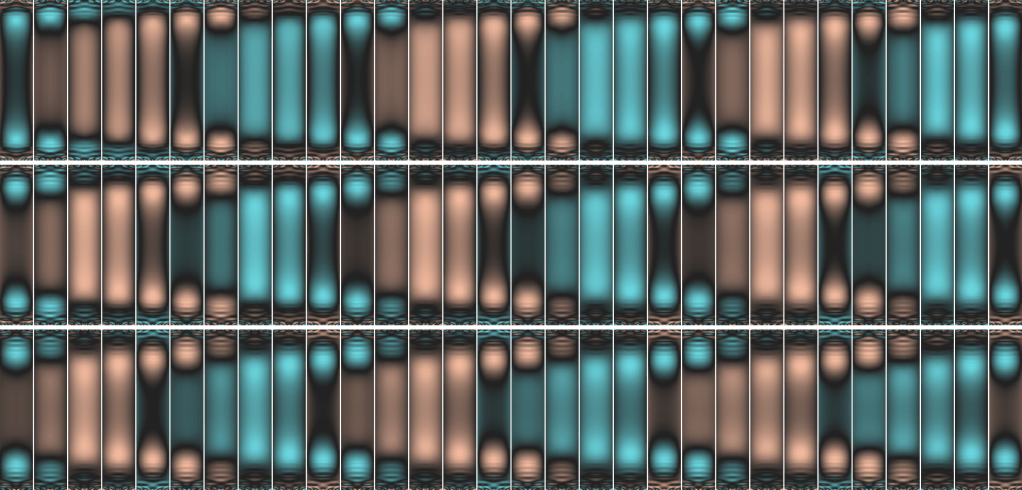
With a simple pedal activation, it is possible to start an excitation of spin waves in one or several of various microstructures of differently shaped tiny pieces. The data visualized and sonified at the exhibit is a result of micromagnetic simulations of a real physical system, which were confirmed by the measurements (so it is happening like that in real life) for one of the shapes. The pedal activation starts the process of pushing the system with periodic uniform magnetic field. By keeping the pedals pressed for longer time visitors can see how spin waves get excited and evolve with time and that for different shapes very different patterns of spin waves are formed. What is interesting is that for the exhibit from the physics point of view everything was set the same for all 5 structures, even thickness, only their lateral shape was differed, meaning that the difference in patterns for different shapes is purely an art of those shapes, so to say.
In order to try to get the feeling of how small and fast are the spin waves in real life one can imagine, that the first part of the exhibit exists in the normal space and time and the second one in an altered space (see image below).
In the normal space and time part of the exhibit one can see an example of a tiny structure used for the research (rectangular strip of a size 1 x 5 micrometer and 30 nanometers thick) in the microscope in a lab-close atmosphere. Next to it a human hair is placed, which is 100 times wider than the strip itself. By switching magnification and trying to see it with one’s bare eyes one can imagine how small it is. And that’s far from the limit for spin-wave based devices and can even be considered huge. But smaller sized structures wouldn’t be possible to be shown in an optical microscope.
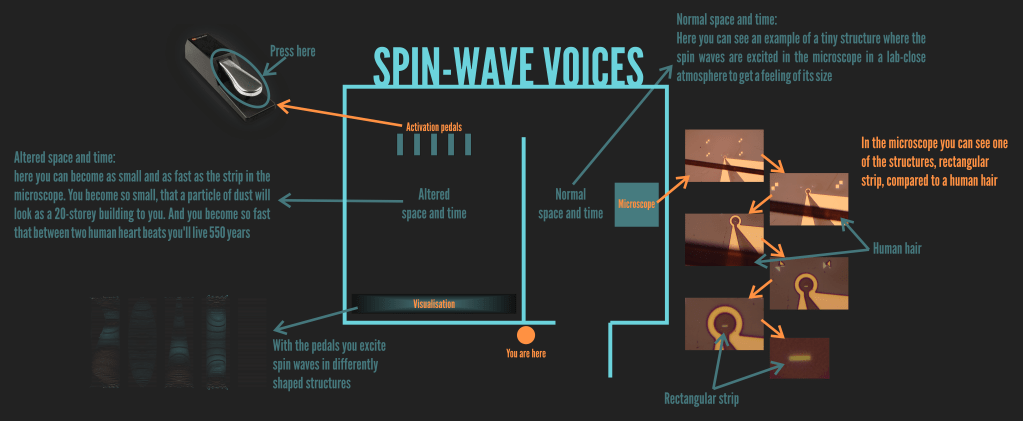
In the second part of the exhibit, the altered space and time, one can become as small and as fast as the strip shown in the microscope. Here one becomes so small, that a particle of dust would look as a 20-storey building, and so fast, that between two normal human’s heart beats one would live 550 years. Here one can find the pedals to excite and enjoy the Spin-Wave Voices.
Sonification details
Spin-Wave Voices uses a variation of Scanned Synthesis [Verplank, W. L., M. V. Mathews, and R. Shaw. 2000. “Scanned Synthesis.” in Proceedings of the International Computer Music Conference, 368–371] to convert data generated by micromagnetic simulations data to audible sound. Audio signals are sampled at 44.1 kHz from 500×100 pixel image streams at 10 frames per second. To accomplish this, we define a periodic audio-rate sampling path through the spatio-temporal data grid; the period of this path defines the fundamental frequency of the resulting musical audio signal while the data itself (which can be also observed in the corresponding visualisation) creates a dynamic, pulsating texture that gives each shape a certain timbre. To generate the audio data, the data is linearly interpolated at the locations defined by the sampling path.
How the project came into being
The research about spin waves in confined structures is conducted in the institute of Semiconductor and Solid State Physics at JKU Linz. As mentioned above, the data shown at this exhibit is a result of micromagnetic simulations confirmed by the measurements by JKU scientists. When analysing the behaviour of spin waves depending on the shape it was noticed that the waves excited at the same time can change a lot with the shape and can be quite various. And the idea came about: hey, how that would sound, and how the sound would change if we change the shape?
Project team
The project team is a very interesting combination of physicists, musicians and data scientists, as the project combines real world physics data, which is analysed, visualised and sonified.
Project lead
Santa Pile (Institute of Semiconductor and Solid State Physics JKU Linz)
Artistic lead
Martin Gasser (University of Applied Arts Vienna)
Visualisation
Santa Pile
Christina Humer (Institute of Computer Graphics JKU Linz)
Sonification
Martin Gasser
Silvan David Peter (Institute of Computational Perception JKU Linz)
Santa Pile
Video production
Santa Pile
Oleg Lesota (Institute of Computational Perception JKU)
Consult/help at the exhibition
Andreas Ney (Institute of Semiconductor and Solid State Physics JKU Linz)
Verena Ney (Institute of Semiconductor and Solid State Physics JKU Linz)
Marc Streit (Institute of Computer Graphics JKU Linz)
 Santa Pile